
I’ve just returned from camping in La Vérendrye Wildlife Reserve, a sprawling natural area in Quebec. My husband, my son and our little Pomeranian Koko were my travelling companions, and canoed and kayaked through rivers and lakes, setting up our tent in a different place each day of our seven day loop.
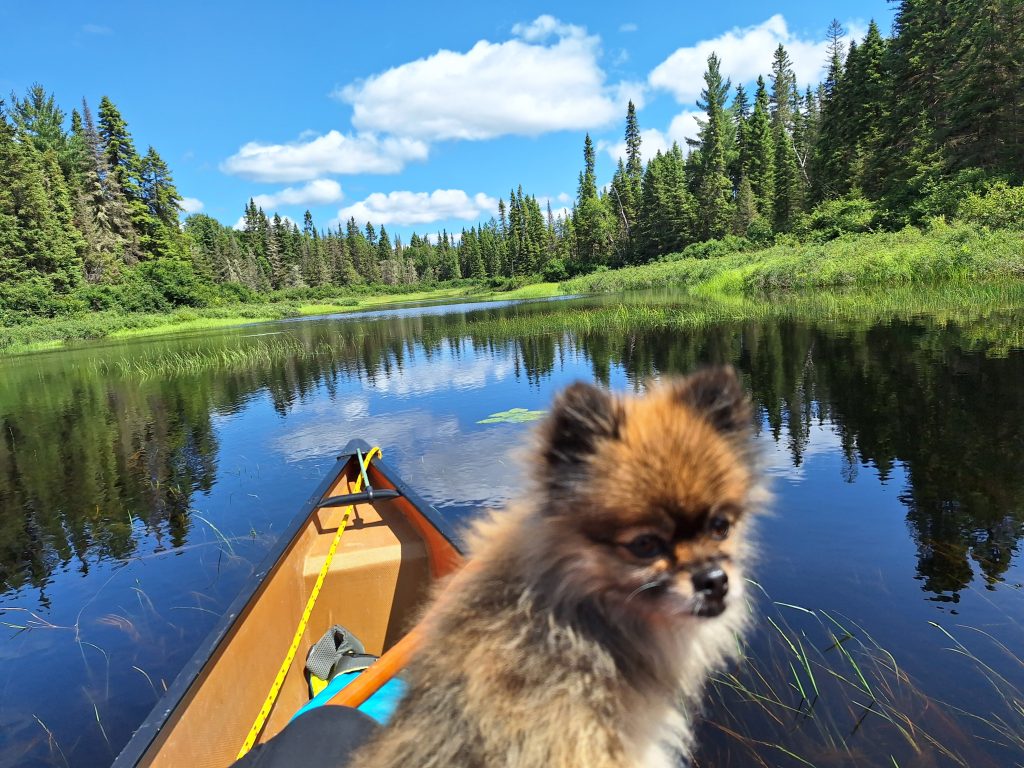
Camping is joyful for me, full of beauty, peace and reconnection with the outdoors that are a refreshing change to my city life.
Yet along with the ease of camping life, comes the hard – the mosquitoes, the rain, the lack of easy access to help if something goes wrong. My life’s work is to learn to flow rather than fight the river that is reality, and so I made sure to inquire into those parts of my camping experience that were stressful. Here are a few of the stressful thoughts I questioned during my journey, and what I learned.
Stressful thought – canoeing is hard.
Some of our routes involve long lake crossings. I can find myself internally complaining about how difficult it is, wishing that we could stop. When I looked more closely, I saw that canoeing is easy. I sit there, and only my arms do the work. Without the thought there was no difficulty in the paddling. What’s actually hard is being still. I’ve realized my ego resists peace and quiet. When it can’t see a problem in the present, it goes to the future – imagining all seven days of the canoe trip, imagining the setup of the tent at the end of the day, imagining the meal preparation. In my mind I’m working the whole time – no wonder I feel tired – it’s my thinking that is hard, not the canoeing. With the thought gone, I live only in the present moment, where paddling is a fluid, gentle motion.
Stressful thought – the bugs are hurting me.
The first two days of the trip I was very conscious of the deer flies, the mosquitoes, all the little critters who sought sustenance from my body. I spent a lot of emotional and physical energy trying to get them away from me, slapping them, killing the ones I could get a hold of, and mentally cursing their existence. In questioning this thought, I realized that when I believe the bugs are hurting me, I see them as genuine enemies, hostile creatures bent on my suffering. And that it’s far more true that I’m hurting the bugs – I’m not just brushing them off me when I become aware of them, I’m actively hunting them down. On this and other trips I’ve killed some bugs with spite and a desire for vengeance or punishment. I have felt hatred for the bugs. These are real feelings, however they make no rational sense, they are simply a result of my beliefs about the bugs. Without the belief, the bugs do their thing, and I brush them away if I notice them. I don’t fight the losing battle of trying to keep them away from me – that never works. I also realized I hurt myself more than the bugs do. I slap myself much harder in an effort to kill the bug than the pinprick of irritation that the bug causes me. Sometimes I am distracted, dropping the paddle or hitting myself with the paddle (hard to describe but if you saw it you’d understand) in my frantic desire to keep the bugs away. And of course, then there’s the scratching at the bites, knowing that scratching can infect the bites and only exaggerates the itching – a temporary relief that is instantly replaced by more itching. So I hurt me far more than the bugs do. Finally, I saw that the bugs are helping me – bugs are an incredibly important part of our world – we could not survive without them. The bugs that are nourished by me go on to feed fish, frogs, birds, contributing to the circle of life and ensuring the health of the forest that I come to visit. When I am camping, I am receiving so much – I am given water and oxygen to sustain life, trees and plants to provide shelter from the sun and rain, eagles to admire as they soar in the sky, sunlight to warm me. I am not required to give anything back. So those snatches of blood that the bugs get from me are one way that I can contribute to the land and wildlife that I visit.
Stressful thought – the rain will not stop.
On our fourth day of canoeing we hit a rainstorm, that lasted for an hour or two and had us thoroughly soaked. We continued to canoe but eventually decided we needed to pull over to the nearest campsite and retreat to our tent. I don’t mind a little rain, but these big downpours cause me a lot of stress. Part of me really believes the rain will not stop. But when I tried on life without that belief, I saw that, the rain, so far, has always stopped. It is my fear of the rain that is so painful. I’m so busy mentally preparing for rain for the next three days that I don’t tend to my immediate needs. I imagine our tent being soaked for days, our sleeping bags being wet through and through, our little dog dying of hypothermia. Those thoughts don’t stop on their own – the mind just runs away into more and more stressful scenarios. So I rail at the sky, wanting the rain to stop so that I don’t have to experience the fear from my mind’s creations. It’s much simpler to just be in the rain, adapt to it when I can, and respond to each moment. If I only need to deal with the rain of one moment, there’s no problem. And I’m more likely to find relief if I tend to my immediate needs, then I can if I’m worrying about how I’ll dry my tent off two days from now.
Stressful thought: My destination is too far away.
On the last day of our trip, I was taking a turn in the kayak. My arms were feeling tired, I had a long stretch of water to cover, and it seemed as if my destination continued to recede, rather than getting closer. So I questioned that it was too far away. And it soon became apparent that the reason I felt tension was because my mind was trying to leap out of my body, to get to the future where I was on shore. I wasn’t able to notice what was around me, the time stretched interminably, all because my mind was so far away into the future. The reality is, so far, I always reach my destination. It’s always just one foot in front of the other – or in this case, one paddle stroke at a time. Our canoe trip would be over soon enough – focussing on the destination deprives me of the journey – and it makes it a lot more difficult! And in fact, it was because my destination was in sight that I was stressing about it – it was too close to ignore. I wasn’t worried about my ultimate home hundreds of kms away in Toronto – that was so far away it wasn’t in my mind. But the shore, now that I could see, which meant my mind could fixate on it – it was too close to ignore. Once I had questioned the thought, and seen that it was only my mind that was too far away, not the destination, I was able to sit back and savour the ride.
Last but not least – It is important to worry.
I had several opportunities to worry on this trip. Our little dog was lethargic and not eating during the first two days, and I was worried about her – that she might die, how would I break the news to my youngest son, was it my fault that she was sick. When the rain came, my mind worried that we would never get out of the rain, and how would we ever dry our tents, our sleeping bags, or reach our final destination. When my son came down our penultimate night with a cold, listening to his stuffy breathing I worried that he would be too sick to lift a paddle, and wondered how we would possibly get out of the park if we had to carry him around with us – picturing him lying prone in the canoe while my husband and I struggled to carry him over the 1 km forest trail portage between lakes. In the moments when I worry, I see my worries and I try to argue with myself, to tell myself not to worry, to focus on the present moment instead. But there is part of me that believes it’s irresponsible to stop worrying about the future and focus on the present. That part of my mind thinks worrying will help solve problems, worrying will prepare me for a difficult future, and worrying will prevent the painful emotions of grief arising when the disastrous scenarios that my mind envisions arrive. When I investigated whether it was true that it was important to worry, it became very clear that it was not. Worrying doesn’t solve future problems – it never does. It only creates them. Trying to solve problems of the future is like trying to solve an equation with one of the variables missing. Only when the future arrives, in the form of the present, will the variable be there to solve whatever problem remains. The dog got better, the rain stopped, my son was strong enough to paddle. Each present moment only required simple actions – making sure the dog got water, putting up a tarp to deal with the rain, choosing a milder pace and frequent breaks when my son or any of us felt tired. Worrying does not prepare me for the future – my stress over the rain made me much less capable to respond to it, my past worries over rain (I had them before the trip even started) hadn’t done a thing to help me when it did rain. Nor am I an accurate predictor of the future. I don’t have a meteorology degree—or the state of mind to assess the weather rationally. I predicted that the rain would last for two days. And it lasted about one hour. It makes no sense to put my stock in my future predictions, that’s not a viable method of solving problems. Worrying does not save me from painful emotions – the body responds to what happens each moment, I can’t save myself from grief or fear or anger in the future by imagining it today – all that happens is that I give myself those painful emotions in the present, where nothing is wrong. Of course, it’s important for my thinking – not me – to worry. That is absolutely the job of the ego – the mind’s job is to look for problems. But it’s up to me whether I believe them or not, once I notice what’s going on. And now that I know it’s not actually important to worry, the next time I catch myself doing it, I’ll be able to take a breath and look at what is in front of me instead of blinding myself with my future predictions.
Our problems are all in the mind
On this trip, as on every other day in my life, reality is in charge. Reality decides what the weather will be, who will be healthy, how many bugs are present in a given moment. None of it is a problem. I have the ability to adapt and respond to reality. But as soon as I choose to fight it, with thoughts like the ones above, I suffer. And it’s so lovely to feel the relief that comes when each thought drops away with the gentle process of self inquiry.
perfect timing to read this as we head up north camping! Gracias Sarah for sharing!!
You’re welcome! Wishing you a wonderful and insight filled trip.
Loved reading this. Took me back to my days sailing in Ontario and swatting at those buggers. They always seemed to enjoy feasting most on my feet. Was also reminded of a day long canoe trip I took while in college in North Carolina on a river that we were surprised to learn that it had very little water in it.
I find that I can’t be reminded too much of the ego’s work. Loved your work on the thoughts that took you away from the moment!!!!
Paddling on a river with low water sounds like a great opportunity to confront reality! Nice to notice that when things don’t go as planned, you get the gift of a memory of an adventure! Really glad this resonated for you.